A$162.6 Million Lost in 2025, and the Reported Total Is a Fraction of the Real One
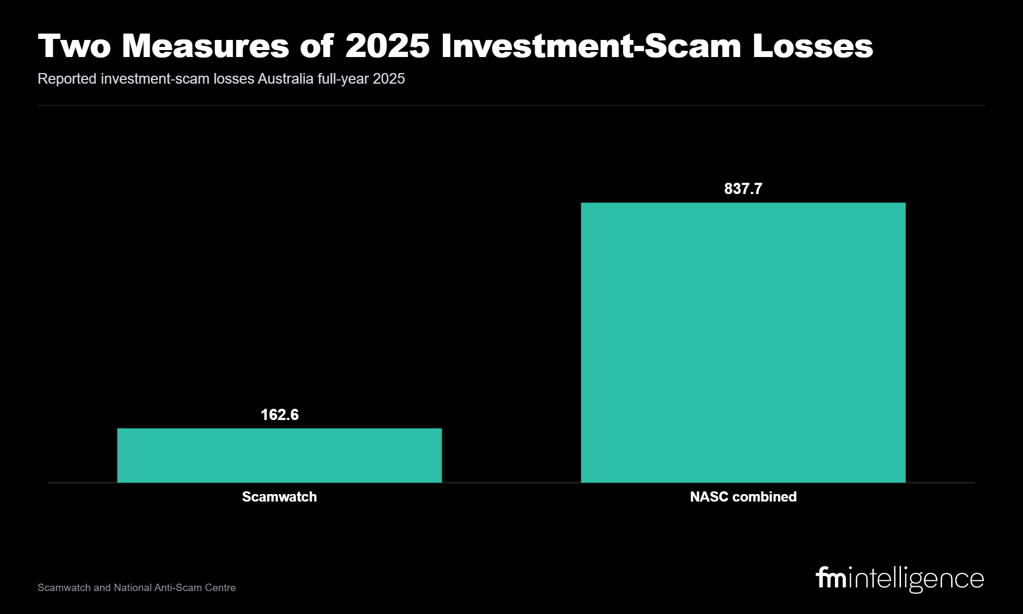
Two official datasets describe the same problem at different scales. According to Scamwatch, the reporting service run by the Australian Competition and Consumer Commission (ACCC), Australians filed 6,955 investment-scam reports in 2025 with reported losses of A$162.6 million. According to the National Anti-Scam Centre (NASC), whose Targeting Scams figures combine Scamwatch, ReportCyber, the Australian Financial Crimes Exchange, IDCARE and ASIC, investment-scam losses reached A$837.7 million, the largest category of scam loss nationally.
The Scamwatch detail for 2025:
• Online contact featured in 3,758 reports, ahead of phone (1,533) and email (833).
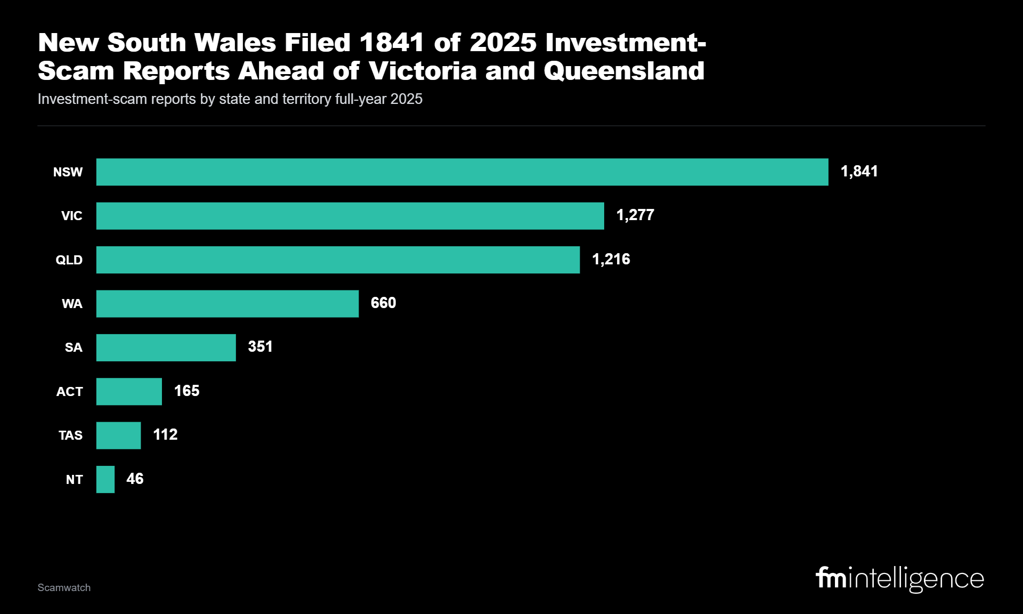
• New South Wales recorded the most reports at 1,841, ahead of Victoria (1,277) and Queensland (1,216).
• Men accounted for 64.87% of losses by amount, women for 34.97%, and X-category reporters for 0.16%.
• Reported losses rose with age, peaking among the 65-and-over group.
The national picture has moved in both directions. According to the ACCC, combined reported scam losses across all categories fell 25.9% to A$2.03 billion in 2024 from A$2.74 billion in 2023, then rose 7.8% to A$2.18 billion in 2025. The 2025 total remained 29.7% below the 2022 peak of A$3.1 billion.
The 2026 data is partial. Scamwatch recorded A$53.2 million in investment-scam losses across 2,220 reports in the first four months of the year, with monthly losses falling from about A$16 million in January to about A$7.5 million in April. ASIC has reported an 11% decline in reported investment-scam losses, though year-to-date figures cover four months and self-reported data captures a fraction of true losses.
Men Accounted for 65% of 2025 Losses, With New South Wales the Most-Reported State
The losses concentrate in identifiable groups. Men accounted for 64.87% of the amount lost to investment scams in 2025 and women for 34.97%. Reported losses rose with age and peaked among people aged 65 and over, a group the ACCC has noted carries a share of total scam losses larger than its share of the population.
.png?width=1024)
By geography, reporting tracked population size. New South Wales recorded 1,841 reports, Victoria 1,277 and Queensland 1,216, together about three-quarters of state-identified reports. Western Australia (660), South Australia (351), the ACT (165), Tasmania (112) and the Northern Territory (46) followed.
11,964 Sites Removed in 2025, Then a Shift Toward Listing the Legitimate Ones
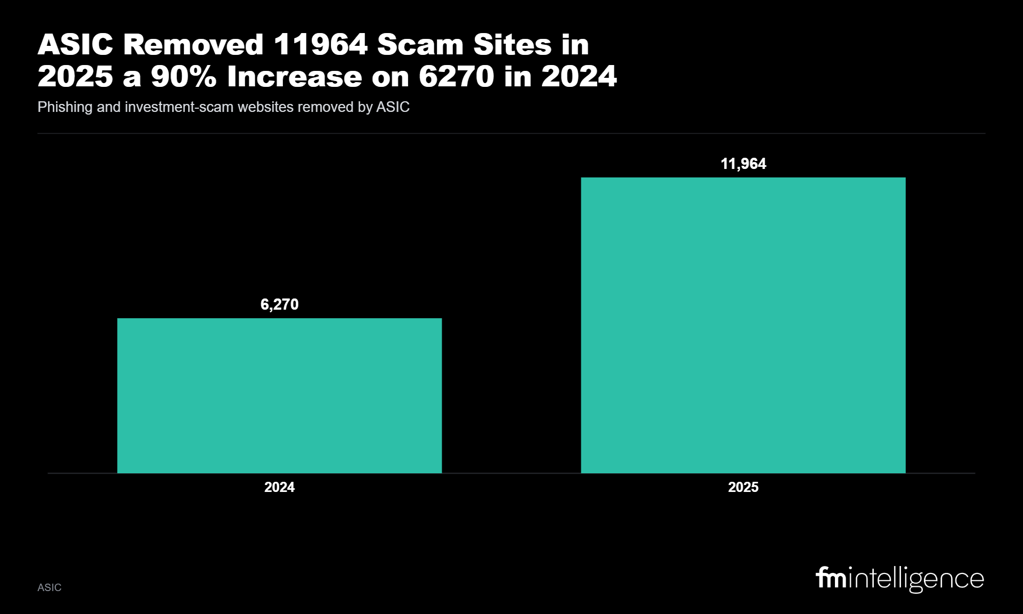
For two years, ASIC’s main anti-scam tool was removal. According to ASIC, its takedown capability removed 11,964 phishing and investment-scam websites in 2025, a 90% increase on the 6,270 removed the year before, at an average of 230 a week and more than 25,000 since the service began in 2023. ASIC also removed more than 1,100 investment-scam advertisements from social media during the year.
The register opened in May 2026 reverses that logic. Rather than removing fraudulent sites after they appear, ASIC is assembling a list of the authentic ones. Its Professional Registers Search, a free public database, now collects and displays the website addresses of Australian financial services (AFS) licensees.
• More than 6,500 licensees were invited to submit website details from May 2026.
• The register shows a licensee’s principal website and any additional sites, flags where a firm operates no website, and flags where one has not yet supplied details.
• Consumers can search by company name, ABN, ACN or AFS licence number.
• Participation is voluntary, and authorised representatives are excluded, though licensees may publish their own verification details for them.
ASIC Commissioner Alan Kirkland signalled the agency could compel participation if too few licensees take part:
“We may consider using compulsory powers to achieve a complete register, if required.” — Alan Kirkland, Commissioner, ASIC
The 20% Gap: Three Conditions That Decide Whether the Register Works
The register targets a measurable problem. According to ASIC, around 20% of new Moneysmart investor-alert listings since late 2023 have involved impersonation of a licensee, an authorised representative or a registered company. The register addresses the licensee portion directly, but its design leaves gaps. FM Intelligence analysis indicates three conditions will determine its effect on losses.
1. Licensee participation. A whitelist works as a negative signal only when it is near-complete. While participation stays voluntary and partial, a missing legitimate site is indistinguishable from an absent one, and consumers cannot safely treat an unlisted site as fraudulent. ASIC’s reference to compulsory powers points at this constraint.
2. Platform integration. The register’s largest potential effect comes not from the individual consumer but from the advertising platform. If search engines and social networks verify financial advertisers’ addresses against the register before running ads, it becomes a filter at the point of distribution rather than a tool a consumer must remember to use.
3. Authorised-representative coverage. Because roughly one in five impersonation alerts involve representatives or registered companies the register does not list, the exclusion of authorised representatives leaves part of the problem unaddressed.
The register also connects to a larger framework. The Scams Prevention Framework Act 2025, which commenced on February 21, 2025, requires designated sectors to prevent, detect, disrupt, respond to and report scams, with penalties of up to A$50 million per contravention. Treasury released draft sector codes on May 28, 2026, including a proposed obligation for digital platforms to check that advertisers of financial products hold an AFS licence. That obligation is where the register’s address list becomes machine-checkable infrastructure.
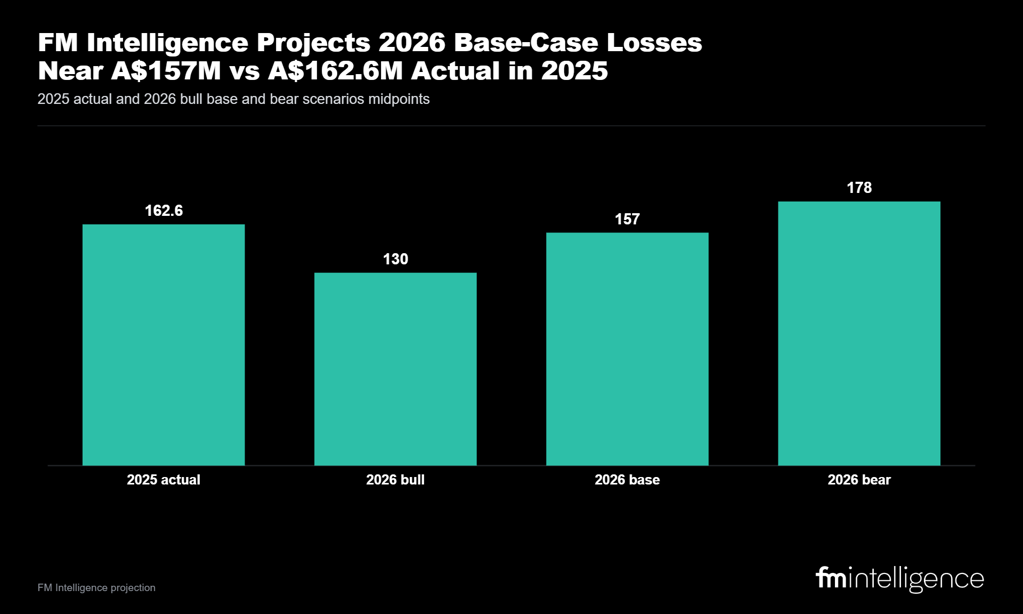
FM Intelligence Projects 2026 Losses Between A$130 Million and A$178 Million
The first four months of 2026 give a short, partial base, which supports scenario ranges rather than a single forecast. Scamwatch recorded A$53.2 million in investment-scam losses through April 2026, an average of A$13.3 million a month. FM Intelligence models three scenarios for the full year, each built on a stated assumption about the remaining eight months and weighted by probability.
|
Scenario |
2026 loss estimate |
Change vs 2025 |
Core assumption |
Probability |
|
Bull (lower) |
A$125-135M |
-17% to -23% |
Monthly losses ease toward the Q2 lower band, near A$9.5M |
30% |
|
Base |
A$152-162M |
-6% to flat |
Monthly losses hold near the year-to-date average of A$13.3M |
50% |
|
Bear (higher) |
A$172-183M |
+6% to +13% |
Second-half losses return to the 2025 monthly range, near A$15.5M |
20% |
The probability-weighted central estimate is about A$153 million, a low-single-digit decline from 2025. The register is unlikely to drive the difference between scenarios on its own within 2026; takedown volume, platform-verification progress under the Scams Prevention Framework, and the pace of AI-assisted scam production carry more weight over this horizon.
Whitelist, Warning List, or Domain Block: How the UK and Italy Take a Different Route
Australia’s whitelist sits at one end of a range of approaches to imposter scams. Two other jurisdictions with detailed public data show the alternatives: the United Kingdom lists the fraudulent firms alongside verifying the genuine ones, and Italy blocks access at the network level.
|
Jurisdiction / regulator |
Primary mechanism |
Scale data |
Built-in limitation |
|
Australia / ASIC |
Whitelist of licensee websites, plus takedowns |
11,964 sites removed in 2025; 6,500+ licensees invited |
Voluntary; excludes authorised representatives |
|
United Kingdom / FCA |
Register verification plus a Warning List of unauthorised and clone firms |
2,240 warnings in 2024; investment-fraud losses £144.4M in 2024 |
Reactive; scammers cite genuine reference numbers |
|
Italy / CONSOB |
Domain-level blocking via orders to internet providers |
1,700+ sites blocked since 2019; 307 in 2025 |
Reactive; blocks access only from within Italy |
According to UK Finance, investment-fraud losses reached £144.4 million in 2024, up 34% on the prior year even as the number of cases fell 24%, the largest single category of authorised push-payment fraud. The Financial Conduct Authority (FCA) issued 2,240 warnings about unauthorised or scam firms in 2024 and, from December 2025, added a consumer-facing Firm Checker to its register. The pairing of verification and a warning list has not stopped UK investment-fraud losses rising.
Italy’s market regulator, the Commissione Nazionale per le Società e la Borsa (CONSOB), takes a different route. Since 2019 it has ordered Italian internet providers to block access to unauthorised investment sites, more than 1,700 to date and 307 in 2025. The block is reactive, taking effect only after a site appears and only for users inside Italy.
To be sure, a register need not cut losses to justify its cost. It is inexpensive to maintain, raises the effort required to operate a clone site, and gives platforms and consumers a reference point that did not previously exist. The evidence from the United Kingdom, where verification and a warning list coexist with rising investment-fraud losses, and from Singapore, where total scam losses fell 17.9% in 2025 after banks and telecommunications firms were made partly liable, points to the same conclusion: a register is one layer in a system, not a substitute for one.
Methodology: Finance Magnates Intelligence analysis draws on investment-scam data published by Scamwatch (ACCC) for full-year 2025 and January to April 2026, and on combined figures from the National Anti-Scam Centre’s Targeting Scams reporting, which aggregates Scamwatch, ReportCyber, the Australian Financial Crimes Exchange, IDCARE and ASIC. Scamwatch and NASC figures are not interchangeable; combined NASC losses exceed Scamwatch-only totals by design. All reported-loss figures are self-reported and represent a fraction of true losses. The 2026 figures cover four months and are not annualised as actuals. The 2026 projection uses run-rate scenarios from the year-to-date monthly average rather than CAGR extrapolation, given the short base; ranges, assumptions and probability weights are stated with the projection and are FM Intelligence estimates that will be revised as ASIC and NASC release further data. Cross-jurisdiction figures use each market’s own currency and reflect differing definitions and reporting methods; they are not directly comparable. Takedown, register and enforcement figures are attributed to ASIC; UK figures to UK Finance and the FCA; Italian figures to CONSOB.